Global
Asia Pacific
Europe
Thursday, 06th November 2025
All the news from XPENG AI Day 2025: discover the innovations in artificial intelligence, autonomous driving and future mobility unveiled by the brand.
Published by ATFLOW XPENG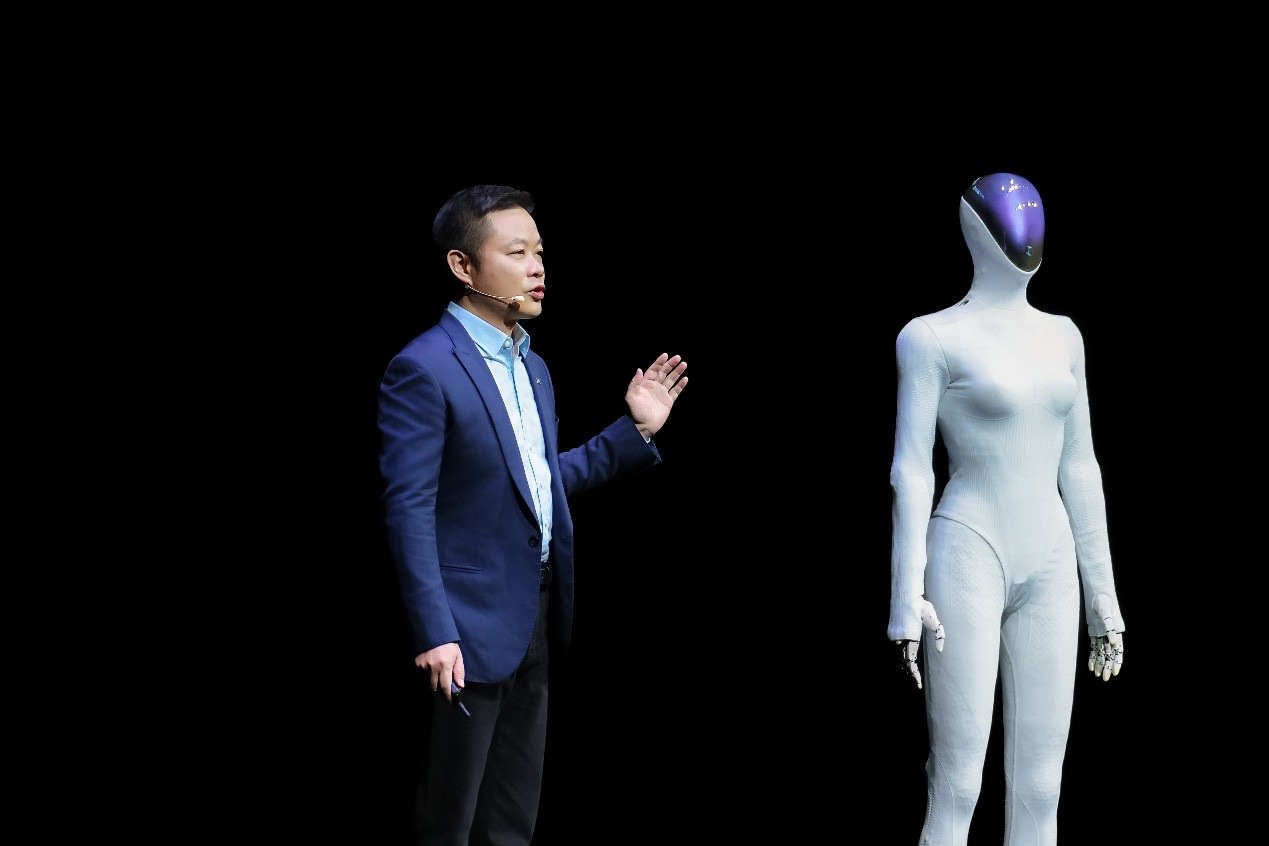
XPENG AI Day 2025: XPENG enters a new era of physical AI and unveils VLA 2.0 and three embodied products: Robotaxi, the next-generation IRON and the flying car.
Last Wednesday, XPENG AI Day 2025, held under the theme “Emergence*”, took place successfully at the new XPENG Science Park in Guangzhou. At the event, XPENG unveiled four major applications centred on “physical AI”: VLA 2.0, Robotaxi, the next-generation IRON, and two ARIDGE aircraft, painting a clear picture of future mobility in the era of physical AI.
What is more, these four AI applications already have precise series-production plans, showing that “physical AI” is no longer a distant dream but a reality within reach.
At the same time, He Xiaopeng, founder and CEO of XPENG, officially announced that XPENG's positioning had been updated to: “an explorer of mobility in the world of physical AI and a global embodied intelligence company”.
(* Emergence in the field of artificial intelligence (AI) refers to the phenomenon whereby an AI system develops complex capabilities or behaviours that were not explicitly programmed or expected from its basic components. In other words, new properties appear spontaneously when the system reaches a certain level of size, complexity or training.)
“AI Day 2025” is the seventh held by XPENG, and marks a crucial year in the company's transformation, moving from an “explorer of future mobility” to an “explorer of mobility in the world of physical AI”. Looking back on more than ten years of innovation and the six previous editions of AI Day, XPENG's bold technology visions are beginning to take shape.
At the conference, He Xiaopeng traced the technological waves of human history and shared his vision: the rise of AI has triggered a new revolution in the digital world. In the physical world, electricity is replacing oil as the main source of energy, and new energy is upending a century-old automotive industry.
When the digital and physical worlds merge, the result is “physical AI”. The wave of physical AI is about to arrive, and XPENG is already ready to meet it. Building on nearly a decade of technological progress, XPENG has built a complete, in-house developed physical AI ecosystem covering several fields: chips, operating systems (large models) and intelligent hardware.
This system forms the technological foundation for XPENG's application across embodied intelligence platforms such as AI cars, Robotaxis, humanoid robots and flying cars.
Driven by technological innovation as its main engine, XPENG will put down lasting roots in the field of physical AI, keep pushing the boundaries of technology and accelerate its transformation into a global embodied intelligence company.
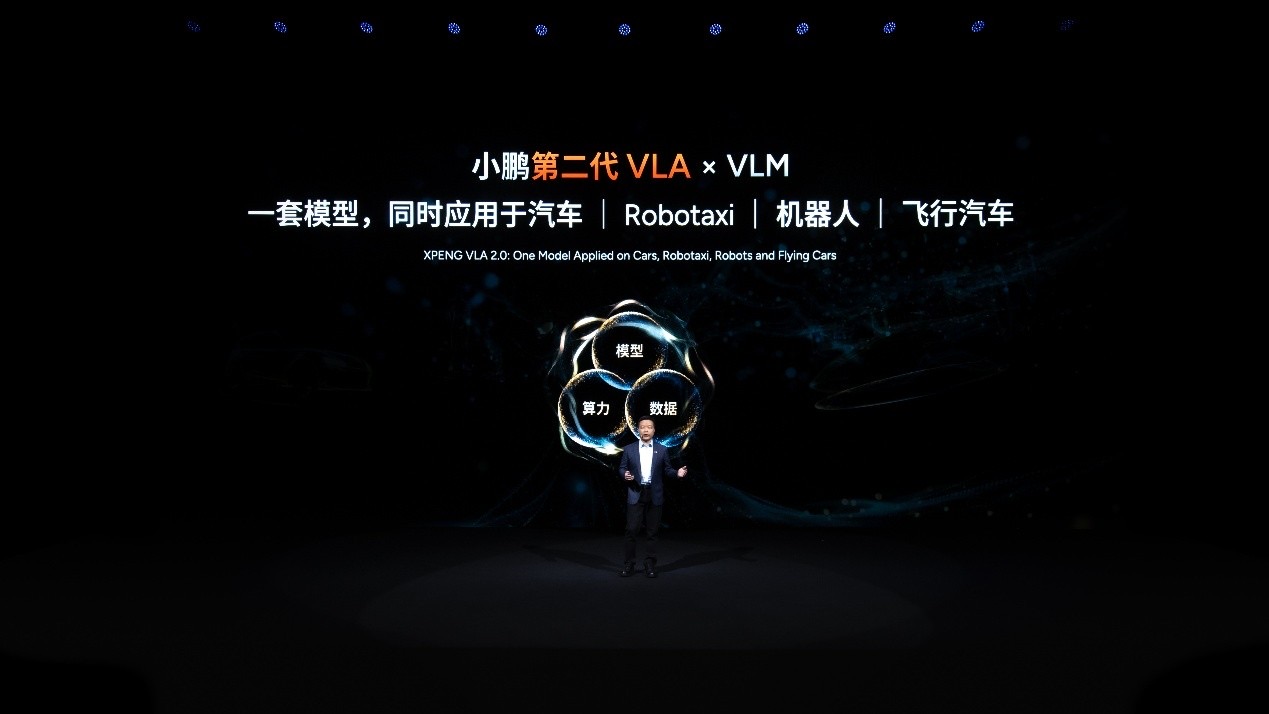
According to He Xiaopeng, in the future “Large Models” will become the “global operating system of embodied AI”, and the foundation of every application in this field. In AI, the combination of “computing power + data + models” has proven that it allows artificial intelligence to evolve and reinvent itself at an unimaginable speed.
At this AI Day, XPENG officially launched its VLA 2.0 “Large Model”, which adopts a new “Vision – Implicit Token – Action” approach.
This architecture innovatively removes the “language translation” step and, for the first time, generates action commands directly from visual signals, revolutionising the industry's traditional “V-L-A” architecture and establishing a new paradigm for the physical model.
VLA 2.0, the first embodied AI “Large Model” put into series production by XPENG, is both a generative action model and a physical world model capable of understanding and prediction. It can also learn in a self-evolving way while absorbing the laws of interaction of the real world. The model is multi-domain and can be applied simultaneously to AI cars, humanoid robots and flying cars.
The “computing power + data” combination is also the main engine driving the evolution of “Large Model” capabilities in the cloud, enabling these models to generate intelligent emergent capabilities at an unprecedented level. XPENG has a cloud computing cluster of 30,000 AI accelerator cards, among the most powerful in the world, with sustained operational efficiency above 90%. In addition, XPENG has already deployed a 72-billion-parameter base model capable of completing a full iteration cycle every five days.
In terms of model training, XPENG VLA 2.0 can directly use immense volumes of real driving video without data annotation. The training volume reaches nearly 100 million clips, equivalent to the sum of the extreme driving scenarios a human driver would encounter in 65,000 years of driving. Thanks to its understanding of the physical world and this speed, VLA 2.0 can infer future scenarios and generate long-tail scenarios for adversarial training, greatly improving its ability to handle rare and complex cases.
Deploying VLA 2.0 on board vehicles is an extremely demanding test of software-hardware collaboration and integration engineering. To achieve mass production of the VLA 2.0 model for in-vehicle use, XPENG redeveloped a dedicated compiler and software stack for the Turing AI chip.
Through optimisation across the whole “chip – operator – model” chain, XPENG has managed to integrate a VLA 2.0 model with billions of parameters into the Ultra version of the vehicle, which has 2250 TOPS of computing power, whereas the models usually used in the automotive industry have only a few tens of millions of parameters.
Based on VLA 2.0, XPENG has launched the “Narrow Road NGP” function, which considerably improves intelligent driving performance in complex environments such as narrow roads or mixed traffic.
As a result, the mean distance per intervention (MPI) in these contexts has been multiplied by 13.
Surprisingly, during testing, VLA 2.0's intelligence demonstrated new emergent capabilities, such as recognising hand gestures, responding proactively to traffic lights, and smoothly handling previously unseen road conditions.
In addition, XPENG was the first in the industry to launch navigation-free driving assistance: the Super LCC system + human-machine co-driving, which can be activated anywhere in the world without relying on GPS navigation. A light nudge of the steering wheel is all it takes for the vehicle to cooperate and carry out a lane change (overtaking) or a turn.
XPENG plans to invite “pioneer” users to co-create and test VLA 2.0 by the end of December 2025, before a full rollout on XPENG Ultra models from the first quarter of 2026.
“To accelerate the global application of physical AI and the co-construction of its ecosystem, XPENG's VLA 2.0 large model will be open source for commercial partners around the world”, said He Xiaopeng.
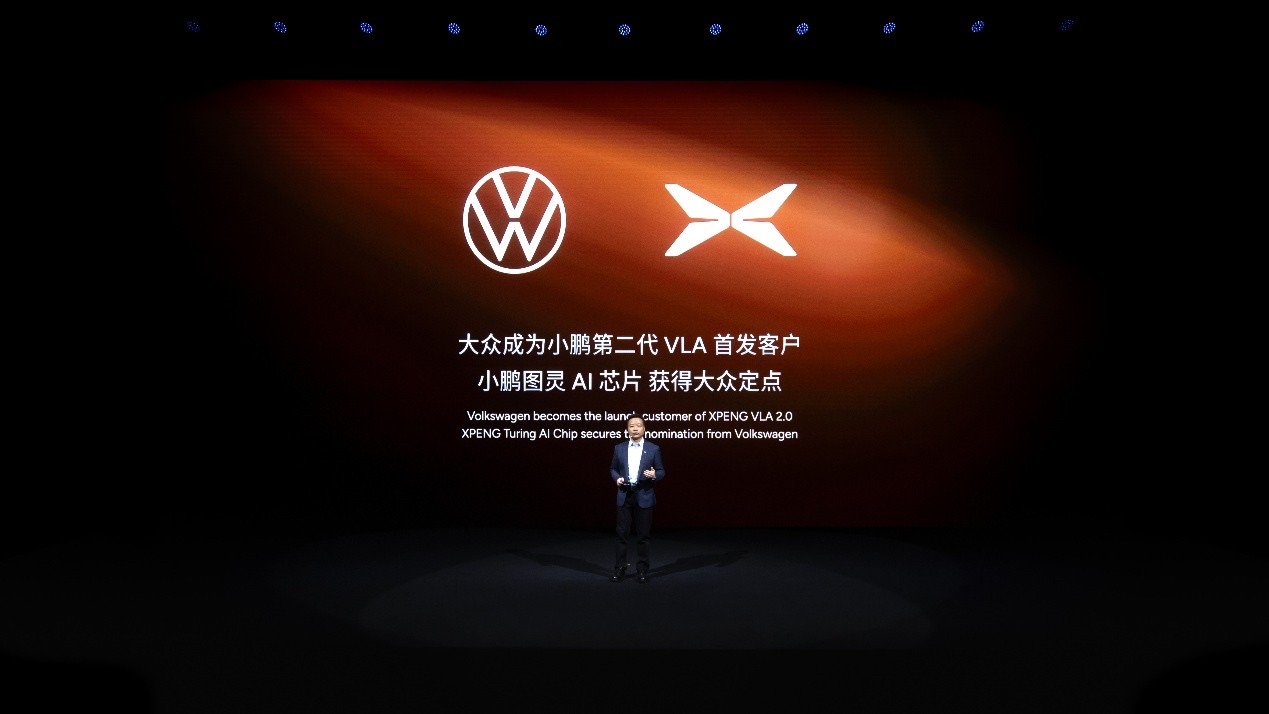
At the event, XPENG also announced that Volkswagen would become the first launch customer for the VLA 2.0 model, and that XPENG's Turing AI chip had received an official nomination from Volkswagen.
At this XPENG AI Day, the company presented a clear vision of future mobility founded on physical AI: three embodied intelligence products — Robotaxi, humanoid robots and flying cars — intended to benefit millions of households, widening users' range of travel while offering a more practical and enjoyable technology experience.
At present, the Robotaxi industry has not yet reached the stage of large-scale adoption. The main obstacles are: high retrofit costs, small fleets, limited operating areas, and numerous regulatory restrictions.
To address these challenges, XPENG plans to launch three Robotaxi models from 2026, and to start pilot operations the same year.
The XPENG Robotaxi will be the first Chinese Robotaxi fully developed in-house and produced in series. At the heart of its autonomous driving hardware and software system, it integrates four Turing AI chips, for on-board computing power reaching 3000 TOPS, the highest standard in the world to date.
Technologically, the XPENG Robotaxi has no dependence on LiDAR or high-definition maps, and can handle different types of roads and traffic environments around the world thanks to a purely vision-based solution.
Designed from the outset to be fully driverless, the Robotaxi relies on the combined capabilities of VLA 2.0 and VLM, enabling ultra-low-latency interaction with the local autonomous driving system. Thanks to VLA 2.0, it can carry out generalised learning, offering greater versatility and faster global deployment.
To guarantee maximum safety, the XPENG Robotaxi adopts a dual-redundant hardware architecture, in which each set can serve as a backup system for the other, ensuring rapid switchover in the event of a failure.
Thanks to the VLM large model, XPENG has developed a new interior and exterior interaction system for the vehicle, including the industry's first external sun-visor screen, giving the vehicle “communication and expression” capabilities. This makes it possible to display visual signals to pedestrians in scenarios such as low-speed driving or parking, strengthening trust and safety in human-machine interactions.
In the future, this system will work with the vehicle's external voice to offer a multidimensional interactive experience combining sight and sound.
Regarding the long-term vision for autonomous driving, XPENG introduced two concepts:
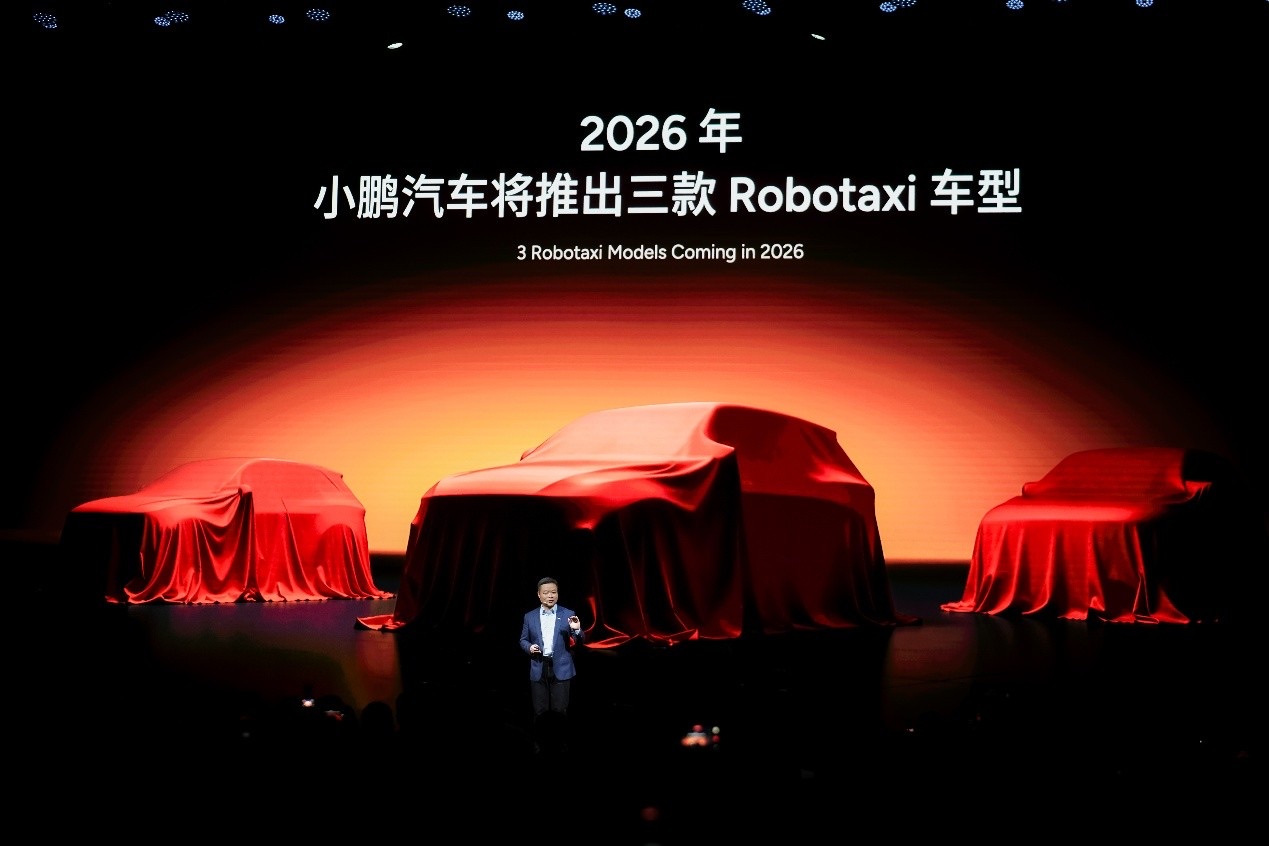
On this basis, in 2026 XPENG will simultaneously launch a new intelligent driving version called “Robo”, from the same technology lineage as the Robotaxi, with the same hardware configuration, the same safety redundancy and the same intelligent driving capabilities, equipped with two autonomous driving modes to meet a range of needs.
To let more users experience this advanced mobility, XPENG will open the Robotaxi SDK and build a global Robotaxi ecosystem with its partners. He Xiaopeng announced:
“Amap will become the first global partner of the XPENG Robotaxi ecosystem, and in the future the two parties will jointly provide Robotaxi services on a global scale.”
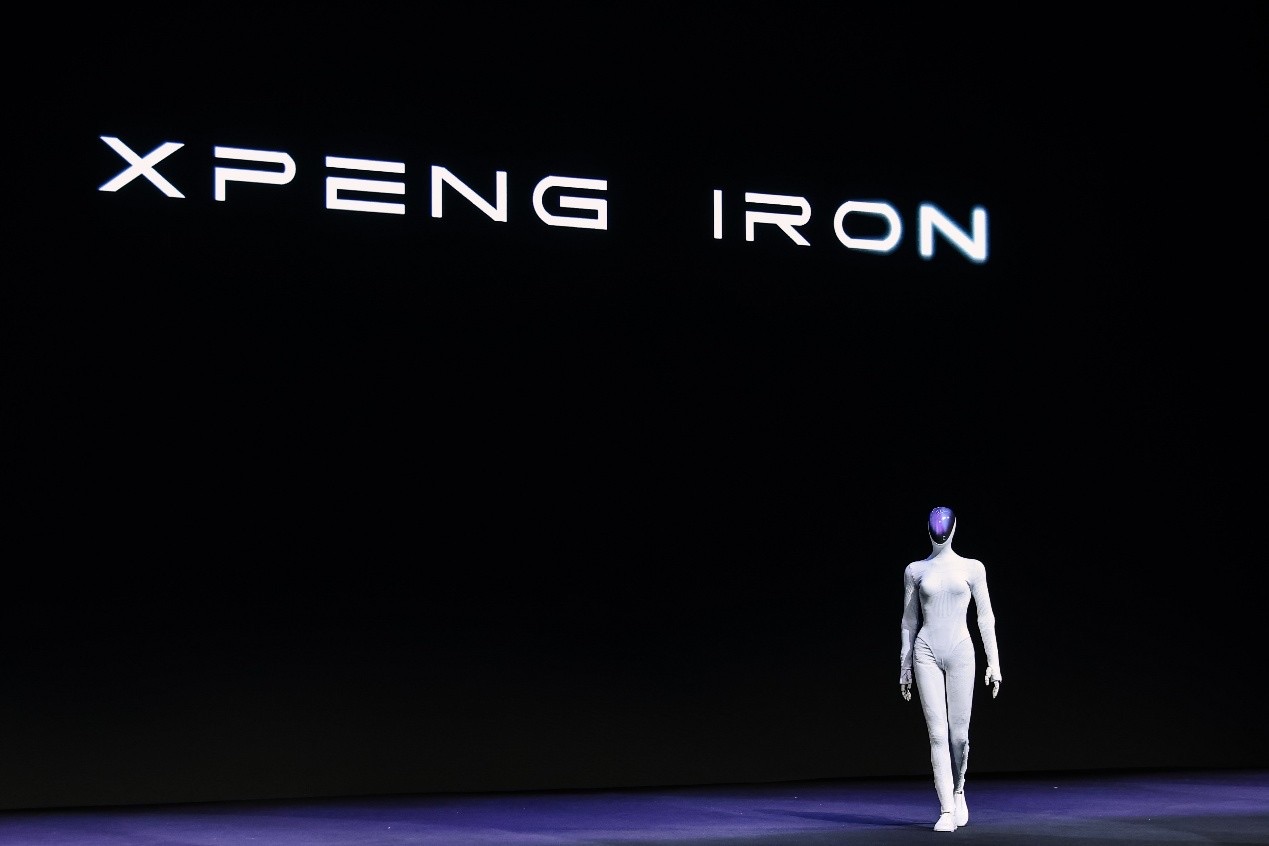
As artificial intelligence sets off a wave of transformation in the digital world, it is also laying the foundations for a new creativity in the physical world. Over the past five years, the form and intelligence of robots have evolved at an unimaginable pace — as shown by the R&D journey and the release of several generations of robots by the XPENG Robotics team. In 2024, XPENG launched its first IRON, whose “humanoid” realism made a deep impression on the public.
Whether robots should resemble humans has long been debated in the sector. XPENG's answer: “anthropomorphism pushed to the extreme”. Because when a humanoid robot reaches an extreme degree of personification, it becomes easier to commercialise, more generalisable, and simpler to train thanks to richer data.
At the conference, the next-generation IRON (female silhouette) made a striking entrance, with its very human appearance and graceful gait reminiscent of a fashion show. Unlike most humanoid robot concepts, its design is based on a “born from the inside” approach: it has a humanoid spine, bionic muscles, full-body soft skin, and even offers body-shape customisation.
With 82 degrees of freedom distributed across the whole body, its movements are natural, fluid and supple, able to perform complex human actions — such as walking a catwalk. Its hands, with 22 degrees of freedom, use the industry's smallest harmonic reducer, at a 1:1 scale with the human hand. The robot also pioneers the use of all-solid-state batteries: a major advance enabling ultra-lightness, record energy density and optimal safety.
Compared with the first generation, the new one benefits from a complete redesign:
achieving ultra-realistic anthropomorphism in both appearance and cognitive interaction.
Equipped with three Turing AI chips, the next-generation IRON delivers an effective computing power of 3000 TOPS. It is also the first robot equipped with the physical-world “Large Model” developed by XPENG. Thanks to the advanced combination of VLT + VLA + VLM capabilities, it achieves three higher forms of intelligence:
It is important to note that the VLT model is a “Large Model” specifically designed for robots: a true engine of autonomous action, it enables them to think deeply and make decisions independently.
On safety, XPENG designed this new IRON not only to respect the Three Laws of Robotics, but added a Fourth Law:
“Private data never leaves the robot.”
This rule aims to maximise privacy protection and guarantee the safety of participants in the world of physical AI.
The development of humanoid robots still faces two major obstacles:
Building on its complete, in-house developed physical AI ecosystem, and on the same technology base as its AI cars, XPENG aims to be the first manufacturer to achieve mass production of humanoid robots.
“By the end of 2026, XPENG aims for large-scale production of high-end humanoid robots”, said He Xiaopeng.
Initially, the next-generation IRON will be deployed commercially for services such as:
Baosteel Stock will become an ecosystem partner for the IRON robot. Zou Jixin, chairman of Baoshan Iron & Steel Co., Ltd., said:
“The XPENG IRON robot will be integrated into Baosteel sites to explore complex industrial use cases — such as inspection — and power Baosteel's intelligent manufacturing.”
He Xiaopeng added:
“To accelerate the development and application of humanoid robots, XPENG IRON will open its SDK and co-build a robotics application ecosystem with developers around the world.”
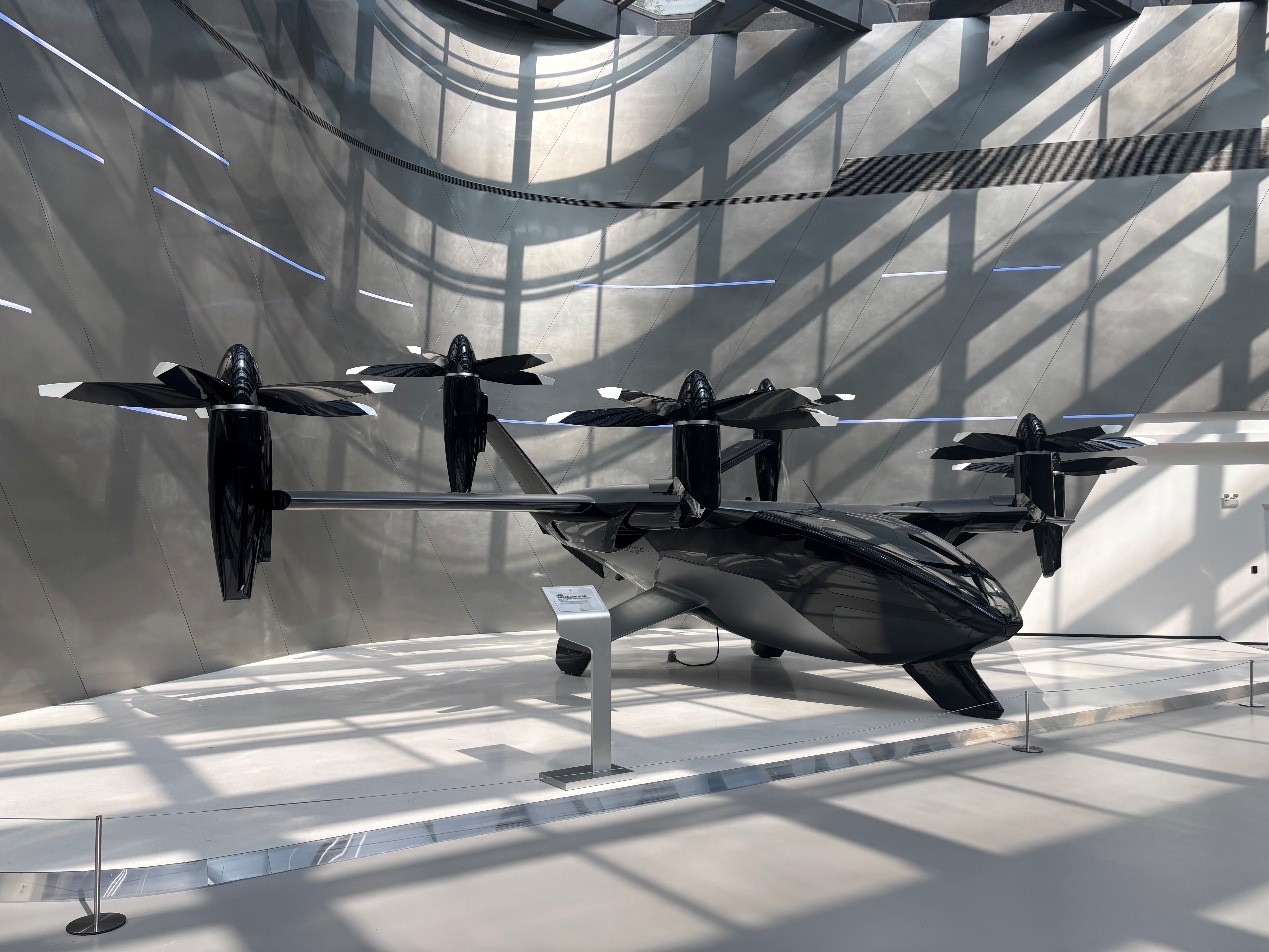
After the wave of new energy vehicles, the low-altitude flight economy is expected to become a new emerging sector estimated at a trillion yuan in China. As part of the aerial extension of embodied intelligence, XPENG ARIDGE (formerly AeroHT) is building two aircraft for low-altitude mobility:
These two systems mark the start of a new era of three-dimensional low-altitude mobility.
Shown publicly for the first time at this XPENG AI Day, the A868 adopts a full tilt-rotor configuration. Based on XPENG's Kunpeng Super Extended-Range architecture, it uses an in-house developed, aviation-grade hybrid-electric system, guaranteeing a continuous and stable energy supply.
The planned performance is impressive:
The A868 has now entered its final flight verification phase, the last stage before series production.
ARIDGE's other product, the Land Aircraft Carrier, is now on the eve of mass production. Global orders already exceed 7,000 units, setting a new industry record.
This vehicle revolutionises the traditional operating logic of aircraft:
On safety, it adopts a fully redundant design covering all key systems:
It uses a six-axis, six-propeller configuration with dual ducted air, guaranteeing flight and landing safety even if two diagonal rotors fail.
On 3 November, the ARIDGE Flying Car mass-production factory began trial production, and the first “Land Aircraft Carrier” successfully rolled off the line.
This facility is the world's first factory to adopt a modern assembly line dedicated to the series production of flying cars, combining aviation quality standards with the efficiency of the automotive industry.
This large-scale production is expected to accelerate the commercialisation of the Land Aircraft Carrier by 2026.
As flying cars move closer to commercial application, low-altitude mobility scenarios are multiplying. More and more people will soon be able to experience this new, three-dimensional form of travel.
To accelerate this transition, ARIDGE will partner with the Dunhuang municipal government to launch, in 2026, the first autonomous aerial tourist route in north-west China, offering an “aerial road trip” experience and helping integrate the flying car into the culture and tourism sector.
Since its creation more than a decade ago, XPENG has remained true to its mission:
“Technology changes the world.”
XPENG Science Park, the group's new headquarters, marks a fresh start. More than 10,000 “XPENGers” work there, covering the fields of AI, automotive, robotics and light aviation. Every day, cross-disciplinary innovations emerge: ideas, technologies and applications influence one another, giving rise to what XPENG calls its own “emergence”.
The spark of this emergence lights up the stars — and the future of physical AI begins here and now.